Commercial Waste Removal Canary Wharf — Insurance & Safety
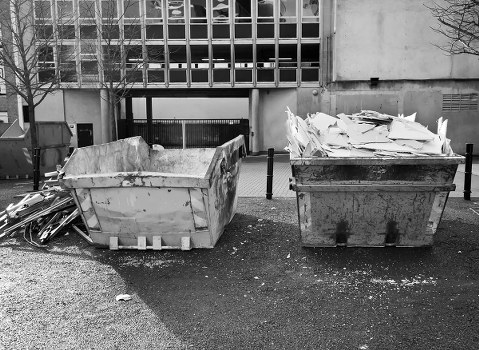 Commercial Waste Removal Canary Wharf demands a rigorous approach to safety and insurance. As an insured rubbish company, we prioritise robust public liability cover, meticulous staff training, and clear risk assessment processes to protect clients, employees and the public in one of London's busiest financial districts. This page explains how an insured waste removal Canary Wharf provider should operate, the types of insurance you should expect, and the safety measures that demonstrate true professionalism.
Understanding the difference between generic commercial waste contractors and a fully insured rubbish company is essential. Your chosen Canary Wharf commercial waste removal team must hold up-to-date public liability insurance, employer's liability cover and vehicle insurance suitable for the scale of operations in Canary Wharf. These policies are not optional; they are the foundation that ensures any accidental damage, injury or third-party claim is managed promptly and without exposing your business to risk.
 Public liability insurance is the most visible protection for clients. It covers claims arising from accidental damage to property or injury to third parties caused by waste removal activities. For commercial waste removal in Canary Wharf, insurers typically expect contractors to carry high limit policies reflecting the dense urban environment. A professional, insured rubbish company will be able to provide evidence of current certificates and outline the scope of cover, including limits, exclusions and renewal dates.
Beyond insurance certificates, strong operational safety comes from the people who do the work. Staff training is central: operatives should be trained in correct lifting techniques, manual handling, vehicle loading, secure containment of waste and safe use of plant and equipment. Training records should be maintained and auditable. For hazardous or specialist waste types, team members may need additional qualifications such as NVQ units, waste transfer note procedures and COSHH awareness.
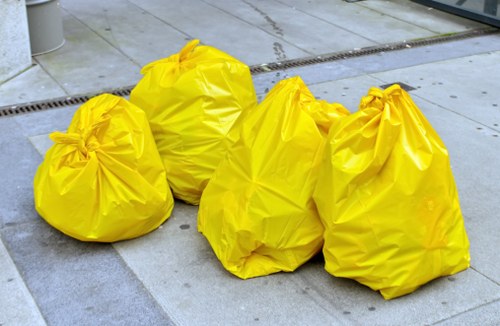 Regular toolbox talks, refresher sessions and scenario drills ensure teams remain aware of site-specific hazards common to Canary Wharf — such as pedestrian traffic, cycle lanes, river-side access and high-rise building logistics. An insured waste removal Canary Wharf contractor will have a structured induction for every new site, with documented training outcomes and a process to update skills as regulations evolve.
Personal protective equipment (PPE) must be provided and enforced. Typical PPE for commercial waste removal includes high-visibility clothing, steel-toe boots, gloves appropriate for the waste type, eye protection and respiratory protection where dust or fumes are present. A responsible insured rubbish company will have a PPE register, policies for use, replacement schedules and checks to make sure equipment fits and is used correctly on every job.
Effective safety management also relies on a formal risk assessment process. Before any collection or site operation, a competent person should conduct a site-specific risk assessment that identifies hazards, evaluates risks and details mitigation measures. Typical steps in the risk assessment process include:
- Site reconnaissance and identification of access constraints.
- Assessment of waste types, weights and containment requirements.
- Evaluation of pedestrian and vehicle interactions, especially on busy Canary Wharf walkways.
- Control measures, including signage, cordoning-off procedures and traffic management.
- Emergency response and first-aid arrangements.
 Risk assessments should be live documents: reviewed at regular intervals, revised after incidents and customised for each job. A trustworthy Canary Wharf commercial waste removal business will store these assessments centrally and make summaries available to on-site managers. The assessment process ties directly into insurance — insurers expect evidence of proactive risk management when underwriting cover or reviewing claims.
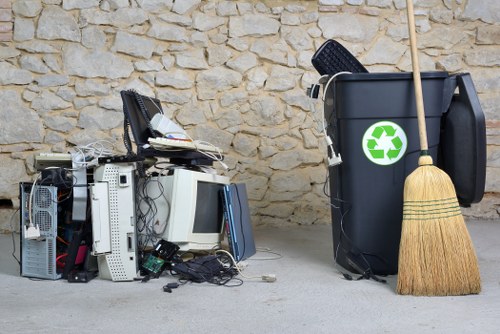 Communication and documentation are the final layers of protection. An insured waste removal Canary Wharf contractor will maintain clear waste transfer notes, duty of care paperwork, insurance certificates and training logs. They will document vehicle maintenance, vehicle insurance schedules and driver qualifications so that every collection is traceable and defensible in the event of an incident. This administrative rigour reduces the chance of disputes and supports swift insurance claims handling.
Additional safety practices include planned vehicle routes to minimise disruption, use of banksmen where visibility is restricted, secure loading and locking of bins, and adherence to local council restrictions on collection times and waste separation. A credible insured waste removal Canary Wharf firm will also have contingency plans for spill response, fly-tip prevention and wet weather operations to reduce slip hazards.
Why choose an insured commercial waste contractor?
Key assurances you should expect
Choosing an insured rubbish company gives you concrete assurances: reduced financial exposure from third-party claims, competent personnel trained in safe practices, consistent use of PPE and a documented risk assessment process that actively prevents accidents. Look for clear evidence of:
- Up-to-date public liability and employer's liability insurance with appropriate limits.
- Comprehensive staff training records and competency checks.
- Enforced PPE policy and equipment registers.
- Structured, site-specific risk assessments and incident review procedures.
In busy urban areas like Canary Wharf, the combination of insurance, training, PPE and risk assessment is not a marketing claim — it is a measurable operational standard. Insured waste removal Canary Wharf providers who commit to these standards deliver safer, more reliable services and protect both client assets and public welfare. When selecting a commercial waste removal partner, insist on evidence of these practices and treat them as non-negotiable criteria for any contract.
